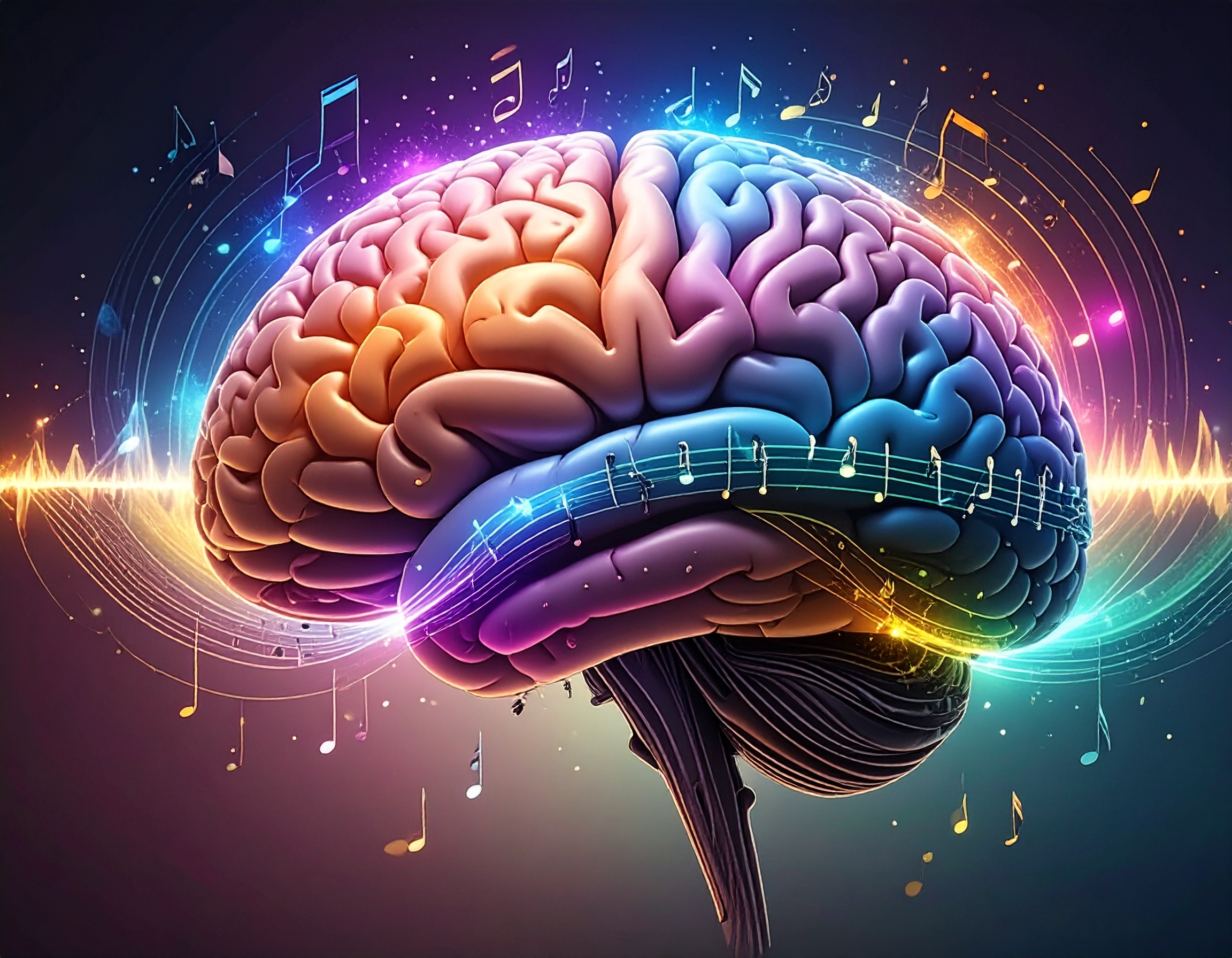
Neuroendokrinologie – Musik, Hormone und Balance
Die Neuroendokrinologie beschreibt, wie Hormone und Gehirn auf Emotion, Klang und Licht reagieren. Musik kann hormonelle Prozesse messbar modulieren.
„Intense pleasure in response to music can lead to dopamine release in the striatal system.“ (Salimpoor et al., 2011, Nature Neuroscience, 14:257–262)
„Listening to relaxing music prior to a stressor was associated with a faster recovery of the autonomic nervous system and a trend for lower cortisol levels.“ (Thoma et al., 2013)
Musik und Hormonregulation
Musik und Hormonregulation
Hörbare Harmonie führt zu neurochemischer Harmonie. Der Körper reagiert auf Musik wie auf emotionale Nähe: mit Dopamin (Motivation), Oxytocin (Verbundenheit) und Serotonin (Wohlgefühl).
„Oxytocin release during group music-making, such as choral singing, fosters trust and empathy.“ (Keeler et al., 2015, Frontiers in Human Neuroscience)
AUDIOSPA und hormonelle Balance
Im AUDIOSPA verschmelzen Musik und Licht zu einer Umgebung, die Ruhe unterstützen soll – also jenen Zustand, in dem Stresshormone sinken und Regeneration beginnen können. Warmes Licht und sanfte Beats regen dabei keine spezifische Hormonreaktion an, sondern können Gleichgewicht fördern.
Quellen
Salimpoor, V. N., Benovoy, M., Larcher, K., Dagher, A., & Zatorre, R. J. (2011). Anatomically distinct dopamine release during anticipation and experience of peak emotion to music. Nature Neuroscience, 14(2), 257–262. https://doi.org/10.1038/nn.2726
Thoma, M. V., La Marca, R., Brönnimann, R., Finkel, L., Ehlert, U., & Nater, U. M. (2013). The effect of music on the human stress response. PLOS ONE, 8(8), e70156. https://doi.org/10.1371/journal.pone.0070156
Keeler, J. R., Roth, E. A., Neuser, B. L., Spitsbergen, J. M., Waters, D. J. M., & Vianney, J.-M. (2015). The neurochemistry and social flow of singing: Bonding and oxytocin. Frontiers in Human Neuroscience, 9, 518. https://doi.org/10.3389/fnhum.2015.00518
Menon, V., & Levitin, D. J. (2005). The rewards of music listening: Response and physiological connectivity of the mesolimbic system. NeuroImage, 28(1), 175–184. https://doi.org/10.1016/j.neuroimage.2005.05.053
Porges, S. W. (2017). The pocket guide to the polyvagal theory: The transformative power of feeling safe. Norton Series on Interpersonal Neurobiology. W. W. Norton & Company.
Weiterführende Literatur
Stefan Koelsch – Good Vibrations (2022)
Daniel Levitin – Music as Medicine (2025)
Robert Sapolsky – Why Zebras Don’t Get Ulcers (2020)